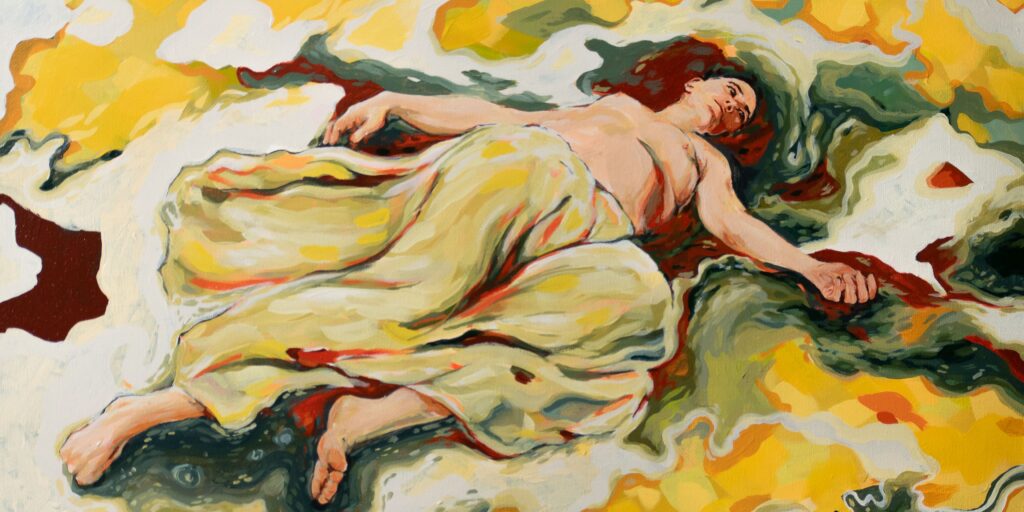
Every work of art begins with a series of decisions. Some are technical, while others are deeply personal. For me, each painting grows from lived experience, memory, and an ongoing curiosity about the psychological landscape of being human.
Visitors often ask why I paint recurring subjects, why many of my figures are nude, or how botanical forms became intertwined with my work. The answer is never a single symbol or story. Instead, my work is shaped by years of observation, reflection, and an evolving understanding of how our inner lives influence the way we experience the world.
This essay offers insight into the experiences, ideas, and artistic choices that continue to shape my contemporary art practice.
Why Personal Experience Matters in My Work
Artists rarely create in isolation from their own lives. Every painting carries traces of the experiences, relationships, and questions that have shaped the person who created it.
Much of my early work began as self-portraiture. Drawing my own body allowed me to process thoughts and emotions that were difficult to express through words. As my practice evolved and I began working from live model resources, the work gradually became less autobiographical in appearance, but remained deeply personal in spirit.
Although my figures are no longer literal self-portraits, they continue to embody questions I have asked throughout my life about identity, vulnerability, belonging, resilience, and transformation. These themes are not unique to me. They are part of what makes us human.
Why I Paint the Human Figure
The human figure remains central to my practice because it provides one of the most direct ways to explore shared emotional experience.
While the body can communicate personal identity, I am often more interested in what exists beneath those outward characteristics. Gesture, posture, and presence become vehicles for expressing emotional and psychological states that words often fail to capture.
In recent years, I’ve become increasingly interested in expanding the range of bodies represented in my work. Human experience is wonderfully diverse, and I want my paintings to reflect that richness with greater intention.
Why Many of My Figures Are Nude
One of the questions I receive most often is, “Why the nude figures?”
For me, nudity is not the subject of the work. It is a formal and conceptual decision.
Clothing immediately introduces information about culture, time, profession, status, and personality. While those details are meaningful in many contexts, they can also redirect attention away from the questions I am trying to explore.
By removing those visual markers, I invite viewers to engage with something more universal. The figure becomes less about a specific individual and more about our shared experience of existing within a body, navigating memory, emotion, uncertainty, and change.
Art as a Way of Processing Experience
Making art has long been a way for me to examine experiences that are difficult to articulate.
During my early twenties, I experienced a period of profound psychological upheaval that fundamentally changed how I thought about consciousness, perception, and identity. While deeply challenging, that period became a catalyst for questions that continue to shape my work today.
Rather than documenting those experiences directly, my paintings investigate broader questions about memory, reality, resilience, and what it means to inhabit a human mind. Over time, the work has become less about processing my own experiences and more about exploring the human condition itself.
Between Observation and Expression
My work exists somewhere between realism and expressionism.
I begin with careful observation of the human figure, but I intentionally allow color, form, and brushwork to move beyond literal representation. Emotional truth often requires more than accurate description.
Rather than recreating exactly what I see, I use expressive color, altered environments, and symbolic relationships to create spaces that feel psychologically authentic.
The Role of Nature
Flowers, plants, and environmental forms appear throughout my work, but they are never included simply as decoration.
Nature functions as a visual language for transformation, memory, resilience, and interconnectedness. Botanical elements often behave like extensions of the figures themselves, reflecting emotional or psychological states rather than physical environments.
Together, the figure and the landscape become inseparable, creating what I think of as internal ecosystems where mind, body, and environment exist in constant dialogue.
Louisiana’s Influence
Growing up in Louisiana shaped my relationship with both landscape and solitude.
The region’s wetlands, dense vegetation, and changing light continue to influence my visual vocabulary. Rather than depicting the landscape literally, I draw upon its atmosphere and ecological complexity to create environments that feel both familiar and psychological.
The natural world becomes less a backdrop and more an active participant in the emotional space of each painting.
Questions That Continue to Guide My Practice
My work rarely seeks definitive answers.
Instead, it returns to questions that continue to evolve:
- How do memory and identity shape one another?
- What does it mean to belong?
- How does grief transform us?
- Where does resilience come from?
- How can painting make invisible experiences visible?
These questions are ultimately more important to me than any single interpretation of an individual artwork.
Looking Beyond the Surface
Every viewer brings their own experiences to a painting, and that exchange is one of the things I value most about art.
While my work begins with personal experience, it is ultimately an invitation for others to reflect on their own memories, relationships, and inner lives. If a painting creates a moment of recognition, curiosity, or quiet reflection, then it has done exactly what I hope art can do.
Frequently Asked Questions
Is your work autobiographical?
Many of my paintings begin with personal experiences, but they are not intended as literal self-portraits. My experiences provide a starting point for exploring broader themes that resonate beyond my own life.
Why do flowers and plants appear so often in your paintings?
Botanical forms function as extensions of psychological and emotional states rather than decorative elements. They help visualize growth, grief, resilience, memory, and transformation.
Is your work surrealist?
My work is rooted in observation but incorporates expressive color, symbolism, and environmental metaphor. Rather than depicting dreams or fantasy, I aim to visualize internal psychological experience.
How would you describe your artistic style?
I describe my practice as contemporary figurative painting with expressive and environmental influences. While grounded in the human figure, my work prioritizes emotional and psychological experience over literal representation.